LG Range Error Code F1: Causes and Repair Guide
LG range error code F1 signals a control board fault. Learn the safe reset steps and repair costs. Call 8338646908 to compare local appliance pros.
By Scott Thompson
Learn more about Appliance Repair or Maintenance for guides, costs, and what to expect.
Compare Appliance Repair or Maintenance Pros Near You
Enter your ZIP code to compare top-rated local professionals and request free quotes.
Your LG electric range beeps, the display flashes F1, and dinner plans grind to a halt. Before you panic or start shopping for a new oven, know this: the F1 code is one of the most common faults on LG ranges, and it almost always points to a communication problem inside the control system, not a catastrophic failure of the appliance itself. In many cases, the fix is straightforward once you understand what the code is telling you.
This guide breaks down exactly what LG range error code F1 means, why it appears on both older and newer LG models, what you can safely check on your own, and when it makes sense to bring in a licensed appliance technician. You will also learn how the repair process works, what it typically costs, and how to avoid the same fault coming back a few weeks later. The goal is simple: help you decide, with confidence, whether this is a quick reset or a job for a professional.
What LG Range Error Code F1 Actually Means
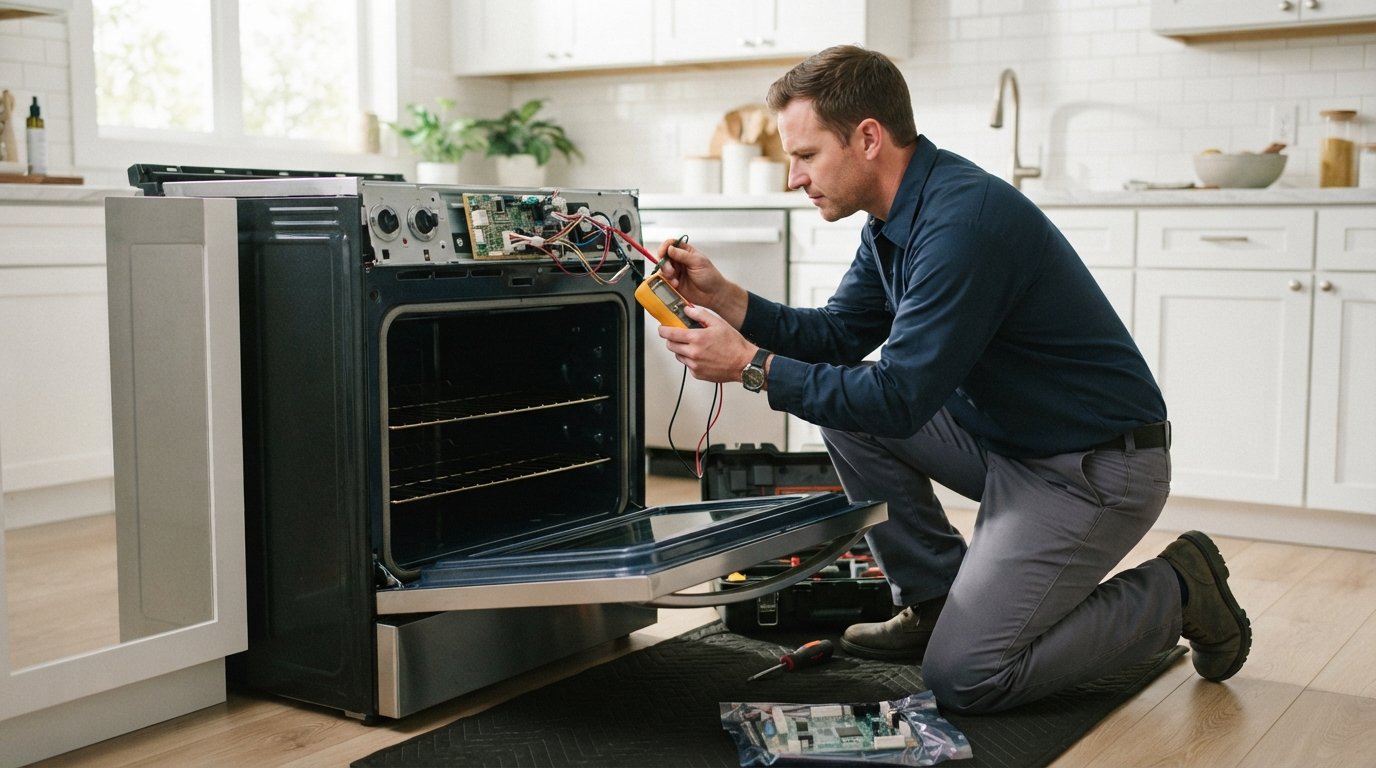
On LG electric ranges, the F1 error is a control board communication fault. The main control board (often called the clock board or display board) and the power relay board or sub-control board talk to each other constantly. When that conversation is interrupted, or when one board receives a signal it cannot interpret, the range locks into F1 as a safety measure and shuts down heating elements until the fault clears.
Because LG uses similar control architectures across many electric range models, F1 shows up on everything from basic coil-top ranges to slide-in convection models. The exact trigger can differ slightly by model, but the underlying cause is almost always one of the following: a loose or corroded wiring harness, a failed control board, moisture intrusion after a spill or self-clean cycle, or a voltage irregularity that scrambled the board's memory.
It helps to think of F1 as the range's way of saying "I lost contact with part of my brain." The heating elements themselves are usually fine. The problem lives in the electronics that tell those elements what to do. That is good news, because control board repairs are generally less expensive than replacing major heating components, and many F1 faults clear after a proper reset or a simple connector reseat.
Common Causes Behind the F1 Fault
Technicians who work on LG ranges see the same handful of culprits again and again. Understanding them helps you describe the problem accurately when you call for service, and it helps you decide whether a DIY check is worth your time.
The most frequent causes include:
- Loose or damaged wiring harness: Vibration, heat cycling, and normal wear can loosen the ribbon cable or wire connectors between the main board and the relay board.
- Failed main control board: Age, power surges, or repeated overheating can damage the board's communication circuitry.
- Moisture intrusion: Boil-overs, steam from the oven vent, or a recent self-clean cycle can push moisture into the control panel area.
- Power supply issues: Low voltage, a tripped breaker that was reset improperly, or a loose terminal block connection can trigger F1.
- Keypad or touch panel faults: On models with membrane keypads, a stuck or shorted button can send continuous signals that the board reads as an error.
Notice that only one of these causes, the failed control board, requires a major part replacement. The rest are connection, moisture, or power problems that a technician can often resolve in a single visit. If your range is a Kenmore unit built by LG, the fault behavior is nearly identical, and our breakdown of the Kenmore range error code F1 diagnosis and repair guide covers the model-specific variations worth knowing.
Safe Steps You Can Try Before Calling a Pro
You do not need to be an electrician to perform a few basic checks, but you do need to respect the power inside your range. A 240-volt circuit can cause serious injury, so every step below begins with shutting off power at the breaker. If you are not comfortable working around the back panel of an appliance, skip straight to scheduling service. There is no shame in that, and it is often the faster path to a working oven.
If you are comfortable proceeding, work through these steps in order:
- Kill the power: Flip the range's double breaker to OFF at your electrical panel. Confirm the display is completely dark.
- Wait and reset: Leave the breaker off for at least five minutes, then restore power. A momentary glitch sometimes clears on its own.
- Inspect the control area: If F1 returns, pull the range forward, unplug it or confirm the breaker is off, and remove the rear access panel to check the wire harness between the boards.
- Look for moisture or burn marks: Any discoloration, corrosion, or dampness around the connectors is a red flag that points to board or wiring damage.
- Reseat connectors: With power off, gently press each connector firmly into its socket. Do not force anything or bend pins.
After reseating connectors, restore power and watch the display. If the code is gone and the oven heats normally through a full preheat cycle, you likely caught a loose connection early. If F1 returns immediately, or if you see any burn marks or smell acrid odors, stop and call a professional. Those symptoms suggest board-level damage that DIY handling will not fix and could make worse.
When to Stop DIY and Hire a Licensed Technician
There is a clear line between a safe homeowner check and a job that belongs in the hands of a trained appliance technician. Crossing that line carelessly risks shock, fire, and further damage to expensive control boards. The following situations should always trigger a professional call:
- The F1 code returns after a proper breaker reset.
- You see burn marks, melted wiring, or smell burning plastic near the control panel.
- The range has recently been through a spill, flood, or self-clean cycle before the fault appeared.
- You are unsure how to safely remove the back panel or identify the control boards.
- The range is still under warranty, since DIY work can void coverage.
For homeowners who want a vetted professional rather than a random listing, Repairmen connects you with licensed, pre-screened appliance technicians in your area. You can compare up to four free, no-obligation quotes, review verified customer ratings, and choose the pro who fits your budget and schedule. That matters because LG control board repairs require model-specific parts, and a technician who works on LG ranges regularly will diagnose F1 faster and source the right board the first time.
If your range is throwing a different fault, the diagnostic logic is often similar across the LG family. Our guide to the Kenmore range error code F3 causes and solutions walks through how oven temperature sensor faults behave, which is useful context if your display cycles between codes or you are troubleshooting more than one issue.
How a Technician Diagnoses and Fixes F1
When a pro arrives, the visit usually follows a predictable pattern. First comes a visual inspection of the control panel, wiring harness, and terminal block. Next, the technician tests voltage at the outlet and the terminal block to rule out a supply problem. Then comes continuity and resistance testing on the harness and boards. Only after those checks does the technician decide whether to reseat connections, replace the main control board, replace the sub-board, or replace the touch panel.
Most F1 repairs fall into one of three outcomes. In the best case, the technician finds a loose connector or moisture and resolves it without parts, often in under an hour. In the middle case, the main control board is replaced, which is the most common parts fix. In the worst case, both the main board and the relay or sub-board are replaced together, which costs more but restores full function reliably. A good technician will explain which outcome applies to your range before starting work and will give you a clear parts and labor estimate.
One detail worth knowing: LG has issued service bulletins for certain model ranges where F1 traces back to a specific harness routing issue. An experienced technician will know whether your model falls into that group. This is exactly the kind of model-specific knowledge that separates a fast, permanent fix from a repair that fails again in a month.
Typical Repair Costs and Repair vs Replace Math
Cost is usually the next question after "can it be fixed." Appliance repair pricing varies by region, parts availability, and whether the board is in stock, but homeowners can plan around general ranges. A diagnostic visit typically runs $75 to $150, and that fee is often applied toward the repair if you proceed. A main control board replacement commonly lands between $250 and $500 total, including parts and labor. If both boards need replacement, expect $400 to $700 depending on the model.
Compare those numbers to replacement. A new electric range costs roughly $500 to $1,500 or more, plus delivery and haul-away. If your LG range is under eight years old and otherwise in good condition, repair almost always wins on value. If the range is older, has needed multiple repairs, or the estimate approaches half the price of a comparable new unit, replacement deserves serious consideration. You can use Repairmen's cost estimators to sanity-check local pricing before you commit, and comparing quotes from multiple technicians keeps the repair price honest.
Preventing F1 From Coming Back
Once your range is repaired, a few habits dramatically reduce the odds of a repeat fault. Keep liquids away from the control panel during cooking, and wipe spills promptly rather than letting them pool near buttons and vents. Avoid running the self-clean cycle on very hot, humid days if your range has a history of control board issues, since the extreme heat and moisture inside the cabinet stress the electronics. If your home experiences frequent brownouts or surges, a whole-home surge protector or a quality appliance surge module is a smart investment that protects every board in the range.
It also helps to record what happened right before the fault appeared. Did someone press a combination of buttons? Was there a storm? Had you just finished a self-clean cycle? That single detail can cut a technician's diagnostic time in half and steer the repair toward the correct part on the first visit. Keep the model and serial number handy too, since they determine which control board your range needs.
Getting Your LG Range Back to Work
LG range error code F1 is a control communication fault, not a death sentence for your oven. Start with a full breaker reset, inspect for moisture or loose connectors only if you are comfortable working with the power off, and call a licensed technician the moment the code returns or you spot burn marks or burning smells. Most repairs resolve with a connector fix or a single control board replacement, and the cost is almost always lower than buying a new range.
When you are ready to hand the job to a pro, Repairmen makes it easy to find vetted, reviewed appliance technicians near you and compare up to four free quotes with no obligation. A working oven is one call away, and you will know exactly what the repair involves before anyone touches your range.
Learn more about Appliance Repair or Maintenance for guides, costs, and what to expect.
Compare Appliance Repair or Maintenance Pros Near You
Enter your ZIP code to compare top-rated local professionals and request free quotes.